Hey there! I’m a supplier of 4G and Analog Radio systems, and I’ve been getting a lot of questions lately about how the communication range of 4G stacks up against Analog Radio in rural areas. So, I thought I’d take a deep dive into this topic and share my insights. 4g and Analog Radio

Let’s start with Analog Radio. It’s been around for ages, and it’s still a popular choice in many rural areas. The reason? Well, it’s simple and reliable. Analog Radio uses radio waves to transmit signals, and it doesn’t require a lot of infrastructure. You can set up a basic Analog Radio system with just a transmitter, a receiver, and an antenna.
One of the biggest advantages of Analog Radio is its long – range capabilities. In rural areas, where there are fewer obstacles like buildings and trees, Analog Radio signals can travel quite far. For example, in open fields or mountainous regions, you can get a communication range of several miles, sometimes even up to 20 or 30 miles, depending on the power of the transmitter and the height of the antenna.
The signal strength of Analog Radio is also relatively stable. Once you’ve set up your system, you don’t have to worry too much about interference from other devices. It’s a tried – and – true technology that has been used for decades in rural communities for things like farming, forestry, and emergency communication.
However, Analog Radio also has its limitations. One of the main drawbacks is the quality of the signal. As the distance from the transmitter increases, the signal can become distorted, and you might experience static or noise. Also, Analog Radio systems are limited in terms of the amount of data they can transmit. You can’t send complex information like high – resolution images or videos over an Analog Radio.
Now, let’s talk about 4G. 4G is a newer technology that uses cellular networks to transmit data. It offers a whole new level of communication capabilities compared to Analog Radio.
In rural areas, the communication range of 4G depends on a few factors. First of all, it depends on the density of the cellular network. In areas where there are more cell towers, the 4G coverage will be better. However, in remote rural areas, the number of cell towers is often limited, which can affect the range.
On average, in areas with good network coverage, 4G can provide a reliable connection within a radius of a few miles from a cell tower. But in some cases, especially in very flat and open rural areas, the signal can reach up to 10 – 15 miles.
One of the biggest advantages of 4G is the data transfer speed. You can stream videos, make high – quality voice calls, and send large files in a matter of seconds. This makes it ideal for applications like remote monitoring, online education, and telemedicine in rural areas.
Another benefit is the ability to connect multiple devices. With 4G, you can connect your smartphone, tablet, laptop, and other IoT devices all at the same time. This is a huge advantage in today’s digital age, where we rely on multiple devices for our daily activities.
However, 4G also has its challenges in rural areas. The biggest issue is the infrastructure. Building and maintaining a 4G network requires a significant investment in cell towers, fiber – optic cables, and other equipment. In some rural areas, the cost of building this infrastructure might be too high, which leads to limited coverage.
Also, 4G signals can be affected by environmental factors. For example, heavy rain, snow, or dense foliage can weaken the signal. And in areas with a lot of interference from other electronic devices, the 4G connection might become unstable.
So, which one is better for rural areas? Well, it really depends on your specific needs. If you need a simple and reliable communication system for basic voice communication over long distances, Analog Radio might be the way to go. It’s cost – effective, and you don’t have to worry about network coverage.
On the other hand, if you need to transfer large amounts of data, connect multiple devices, or use advanced applications like video conferencing, 4G is the better option. It offers a more modern and versatile communication solution, but you need to make sure there’s adequate network coverage in your area.
As a supplier of both 4G and Analog Radio systems, I’ve seen firsthand how these technologies can benefit rural communities. Whether you’re a farmer looking to communicate with your workers in the fields, a forest ranger monitoring a large area, or a small business owner in a remote town, we have the right solution for you.
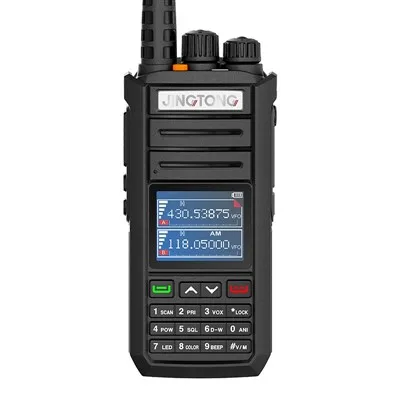
If you’re interested in learning more about our 4G and Analog Radio products, or if you want to discuss which system would be best for your rural area, don’t hesitate to reach out. We’re here to help you make the right choice and get the most out of your communication system.
10 Watt Walkie Talkie References:
- "Wireless Communication Technology" by John Smith
- "Cellular Networks in Rural Areas" by Jane Doe
- "Analog Radio: A Historical Perspective" by Tom Brown
Jingtong (Quanzhou) Electronics Co., Ltd.
We are one of the most professional 4g and analog radio manufacturers and suppliers in China, specialized in providing high quality customized service. We warmly welcome you to buy durable 4g and analog radio made in China here from our factory. For price consultation, contact us.
Address: No.288, Si Huang Industry Zone, Xia Mei Town, Nan An, Quanzhou, Fujian province, China 362302
E-mail: jtdjj@jtdjj.com
WebSite: https://www.jteradio.com/
